
In short: Colic is when an otherwise healthy baby cries for more than 3 hours a day, at least 3 days a week, for no obvious reason. It usually starts at 2–3 weeks, peaks around 6 weeks and is mostly gone by 3–4 months. Closeness, rocking, steady noise and calm feeds help; the NHS does not recommend colic drops or herbal remedies.
Author: Eva Birsa, mum and co-founder of Evitas · Updated: 9 November 2026
What is baby colic?
Colic means long spells of crying that are hard to settle in a baby who is otherwise healthy, feeding well and gaining weight. The NHS describes it with the "rule of three": crying for more than 3 hours a day, 3 days a week, for at least 1 week. Some health sources use a duration of at least 3 weeks. Crying is often worst in the late afternoon and evening.
While crying, a baby with colic often clenches their fists, goes red in the face, draws up their knees or arches their back, and their tummy may rumble. The exact cause is unknown. Experts point to an immature ability to regulate crying and sleep, greater sensitivity to stimulation and swallowed air, but in most babies there is no digestive illness. Colic is common and is not caused by anything parents have done wrong.
When does colic start and end?
| Age | What is typical |
|---|---|
| 2–4 weeks | crying starts to build up, often at the same time of day (AAP) |
| around 6 weeks | crying peaks – it can be about 3 hours a day (AAP) |
| 3–4 months | colic stops in most babies (NHS) |
| after 4 months | rarely still present – talk to a doctor (NHS) |
When to see a doctor
Before crying is put down to colic, a doctor should rule out other causes. Do not wait if you notice any of these signs:
| Sign | What to do |
|---|---|
| a weak, high-pitched or unusual cry; the baby is very weak, floppy or unresponsive | call your emergency number now (112 in the EU, 999 in the UK) |
| a high temperature in a baby under 3 months | contact a doctor straight away |
| vomiting, blood in the stool, a swollen or tense tummy, a bulging soft spot | contact a doctor straight away |
| feeding poorly or refusing feeds, not gaining weight | see your doctor |
| crying when touched or moved; non-stop crying for more than 2 hours | see a doctor today |
| colic symptoms after 4 months, or nothing helps | see your doctor |
| you are exhausted or afraid you cannot cope | talk to your doctor, health visitor or someone close to you |
Trust your instincts: if you feel something is seriously wrong with your baby, get help.
What helps with colic
No single measure works for every baby. Choose a few calm techniques and use them consistently – constantly switching can unsettle a baby even more.
Soothing
- Closeness: hold and cuddle your baby; you will not "spoil" them.
- Gentle rocking and movement: in your arms, in a carrier or on a walk in the pram.
- Steady background noise: white noise, a fan or a vacuum cleaner (AAP); never place a baby on top of a washing machine or dryer.
- A warm bath and gentle massage of the tummy or back.
- Tummy-down hold: lay your baby tummy-down along your forearm or across your knees and gently rub their back. If they fall asleep, put them on their back in the cot.
- Less stimulation: a dimmed room, a quiet voice, a calm routine.
Feeding
- Keep breastfeeding as usual; according to the NHS, breastfeeding mothers do not need to change their diet.
- Hold your baby semi-upright during feeds, then keep them upright and wind them afterwards.
- Paced bottle feeding: hold the bottle almost horizontal so the teat is full of milk, allow breaks and follow your baby's cues that they have had enough.
- Choose a slow-flow bottle teat so your baby does not drink too fast.
- Avoid overfeeding (AAP).
Do anti-colic bottles help?
Anti-colic bottles with a valve, vent system or wide teat can reduce how much air a baby swallows while drinking. They do not cure colic – the NHS says there is no evidence that one type of teat or bottle is better than another. Feeding technique matters just as much. We explain how to choose the system, flow and size in our guide Anti-colic bottles: how to choose and do they really help?.
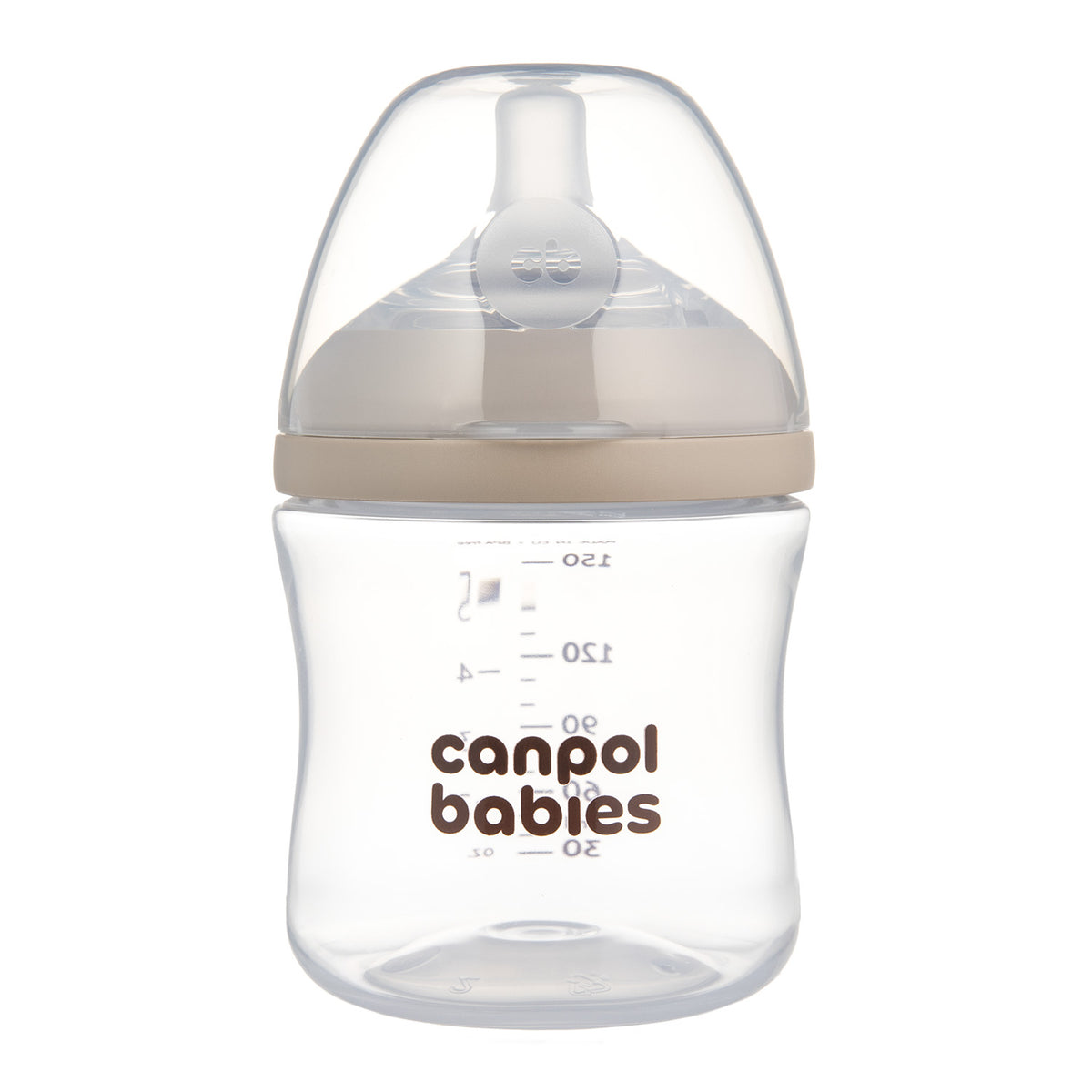
Examples from our range: according to the manufacturer, the Canpol babies Natural Shape 150 ml has a wide-based teat that only releases milk with active sucking, plus a mini flow for newborns. The LOVI Mammafeel 150 ml has a wide teat made from two types of silicone for a close lip seal; for the youngest babies there is the Mammafeel 0m+ MINI teat. You will find more choice among our bottles with teats and in the LOVI and Canpol babies collections. If you combine breast and bottle, read Combination feeding: breast and bottle without the confusion too.
What lacks evidence or needs caution
| Measure | What the sources say |
|---|---|
| holding, rocking, white noise, warm bath | recommended by the NHS; safe and worth trying |
| upright position, winding, slow flow | recommended by the NHS; reduces swallowed air |
| anti-colic bottle | can reduce swallowed air; no evidence that one type is better (NHS) |
| colic drops (e.g. simethicone, lactase) | not recommended by the NHS – no evidence they help |
| probiotics | not recommended by the NHS; a meta-analysis (Pediatrics, 2018) found an effect of L. reuteri DSM 17938 only in breastfed babies, with too little evidence for formula-fed babies – only after talking to your doctor |
| herbal teas, gripe water, herbal remedies | not recommended by the NHS – no evidence |
| chiropractic, cranial osteopathy | little evidence and may cause harm (NHS) |
| switching formula, changing a breastfeeding mother's diet | only on a doctor's advice (AAP); food is the cause in fewer than 5% of colicky babies |
Do not give your baby medicines or supplements without advice from a doctor or pharmacist.
How to cope: tips for parents
Inconsolable crying is exhausting and can be one of the hardest parts of the early months. The ICON programme sums it up in four messages:
- Infant crying is normal and gradually eases after peaking at around 6 to 8 weeks.
- Comforting methods can help, but not always – that is not your fault.
- It's OK to walk away: put your baby on their back in a safe cot, close the door and take 5 to 10 minutes to calm down.
- Never, ever shake a baby. Even brief shaking can cause permanent brain damage or death.
Take turns with your partner, ask family or friends for help and tell your doctor if you feel at the end of your tether or low. In the UK, the Cry-sis helpline (0800 448 0737) offers support.
Frequently asked questions
How do I know if it is colic or something else?
With colic, a baby otherwise feeds well, gains weight and seems normal between crying spells. If your baby has a high temperature, is vomiting, feeding poorly or the cry sounds different, there may be another cause – see a doctor.
How long does colic last?
It usually peaks around 6 weeks and is mostly gone by 3 to 4 months. If it lasts longer, talk to your doctor.
Do colic drops work?
The NHS does not recommend colic drops, herbal or probiotic supplements because there is no evidence they help. There is some evidence for the probiotic L. reuteri in breastfed babies only – decide together with your doctor.
Should I switch formula?
Not on your own. Food allergy or intolerance is a rare cause; your doctor will decide whether a special formula is needed.
Does an anti-colic bottle prevent colic?
No. It can reduce swallowed air, but the cause of colic is unknown. Feeding position and pace matter too.
Can I "spoil" my baby by holding them all the time?
No. In the first months babies do not form bad habits from being held; closeness calms them.
Sources
- NHS – Colic
- NHS – Bottle feeding advice
- AAP / HealthyChildren.org – Colic Relief Tips for Parents
- AAP / HealthyChildren.org – Crying Baby: Before 3 Months Old
- NHS Mid Yorkshire – ICON: babies cry, you can cope
- Sung et al. – Lactobacillus reuteri to Treat Infant Colic: A Meta-analysis (Pediatrics, 2018)
- UNICEF Parenting – Why babies cry
This content is for information only and does not replace advice from your paediatrician.